
Resources
Strut Channel Sizes: 1-5/8” vs 7/8”, What the Numbers Mean
The difference between 1-5/8” and 7/8” strut channel, standard gauges, and how to read Unistrut-style part numbers before you order.

Strut Channel
Two sizes cover the vast majority of strut channel used in mechanical, electrical, and plumbing work: 1-5/8” and 7/8”. Both come slotted, both are dimensionally standard across manufacturers, and mixing them up on a materials list is one of the more common ordering mistakes on a job.
1-5/8” channel is the standard, heavy-duty profile. It’s what you reach for on pipe racks, cable tray support, multi-run trapeze assemblies, and anywhere the load adds up. If a spec just says “Unistrut” or “strut channel” without a size called out, 1-5/8” is the safer assumption.
7/8” channel, sometimes called “half-slot” or junior channel, is a lighter profile. It’s common on single conduit runs, small equipment mounts, and signage, where 1-5/8” would be overbuilt, and more expensive, for the job.
Reading the part numbers
Industry-standard part numbers (originally Unistrut’s own numbering, now used generically across manufacturers) tell you the profile and gauge at a glance:
| Part # | Profile | Gauge |
|---|---|---|
| P1000 | 1-5/8” x 1-5/8”, slotted one side | 12 ga |
| P3300 | 1-5/8” x 7/8”, slotted one side | 12 ga |
| P4100 | 1-5/8” x 13/16”, slotted one side | 14 ga |
| P5500 | 1-5/8” x 2-7/16”, slotted one side | 12 ga |
| P1001 | 1-5/8” x 3-1/4” back-to-back (double), slotted both sides | 12 ga |
A lower gauge number means thicker steel, 12-gauge is thicker (and stronger) than 14-gauge. If your spec calls out a gauge, it’s worth checking it against the part number rather than assuming.
Reference drawing
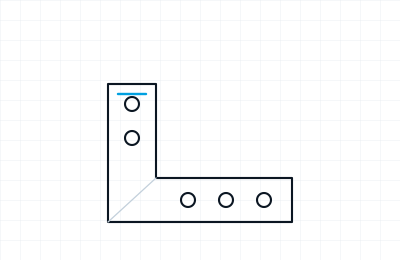
Brackets, clamps, and channel nuts are sized to a specific channel width, match your hardware to the profile you ordered above.
Which one do you need?
If you’re specifying for a job and aren’t sure, the safest default is 1-5/8” (P1000), the most common profile in the field and compatible with the widest range of brackets, clamps, and fittings. 7/8” is worth choosing specifically when weight and cost matter more than capacity margin, not as a default.
Contractor FAQ
Is “Unistrut” the same as generic strut channel?
Unistrut is a registered trademark (Atkore). The part-numbering convention (P1000, P3300, etc.) is used industry-wide as shorthand for dimensions and gauge, strut channel from any manufacturer built to those dimensions is functionally interchangeable with brackets, nuts, and fittings rated for the same profile.
Can I mix 1-5/8” and 7/8” fittings on the same run?
No. Brackets, clamps, and channel nuts are sized to a specific channel width and won’t seat correctly on the other profile. Match your hardware to your channel size.
What’s the minimum order?
We sell strut channel wholesale, by the bundle, minimum order is 50 pieces. Request specs & pricing and we’ll confirm exact bundle counts for your size.
Keep Reading
All Thread Rod
Threaded rod runs through strut channel on most trapeze and support assemblies.
See what you’re overpaying.
Send us your usual materials list and we’ll show you the direct-source price. No obligation.